

When Less Waste Leaves a Bigger Footprint in 3D Printing
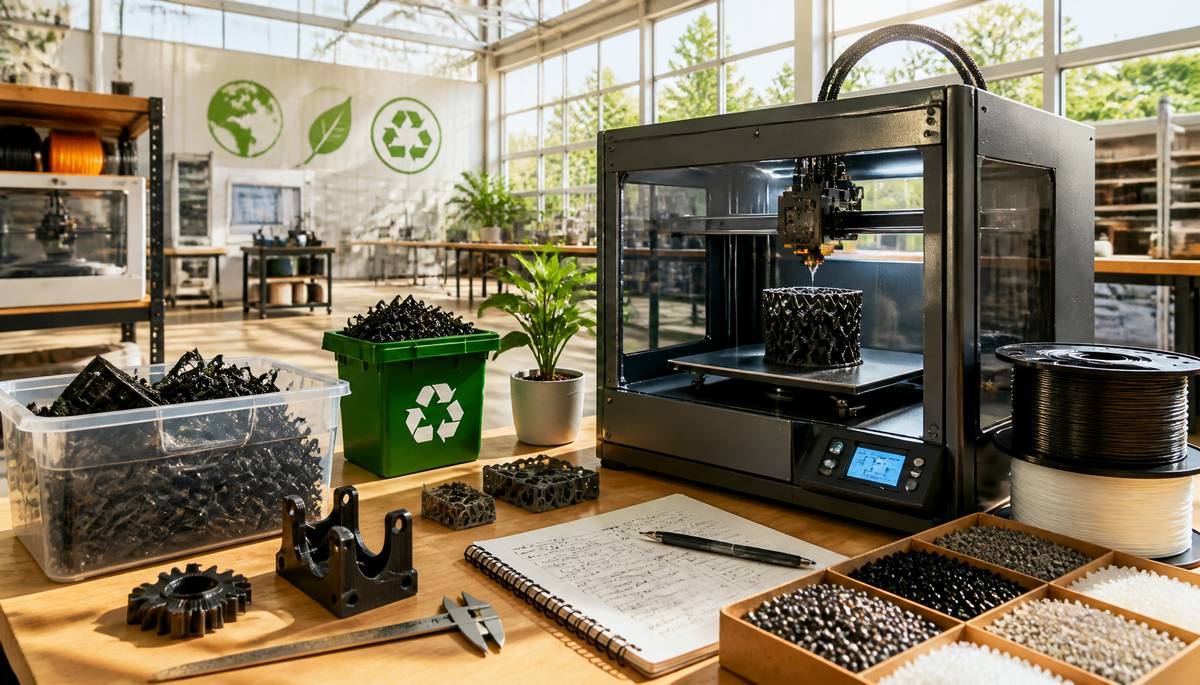 A plastic component weighing fifty grams might require several kilograms of machinery, hours of electricity and a surprising amount of environmental optimism to produce. That is one of the peculiar contradictions surrounding 3D printing, a manufacturing technology frequently celebrated for its ability to reduce waste. Although additive manufacturing offers genuine environmental advantages, the relationship between using less material and producing something sustainably is considerably more complicated than it first appears.
Traditional manufacturing often involves cutting, drilling or machining material away from a larger block. Additive manufacturing approaches the problem differently, building objects layer by layer. It sounds wonderfully efficient, particularly when compared with machining a component from a solid piece of expensive material. However, material efficiency represents only one part of a product's environmental footprint.
Less Plastic Doesn't Necessarily Mean Less Pollution
One of 3D printing's strongest environmental arguments concerns material utilisation. Instead of removing unwanted material, printers deposit or fuse material where the design requires it. Complex internal structures can also reduce the weight of components without sacrificing necessary strength.Nevertheless, printers consume electricity, sometimes considerable amounts of it. Industrial processes such as selective laser sintering require equipment to maintain elevated temperatures throughout lengthy production cycles. The electricity required to heat a powder bed, operate lasers and run supporting equipment can make a relatively lightweight component surprisingly energy-intensive.
The source of that electricity matters enormously. A printer powered by renewable energy may have a substantially different environmental impact from an identical machine operating on electricity generated primarily from fossil fuels.
Production volume also changes the calculation. Injection moulding requires substantial initial investment in tooling, but once a mould exists, thousands of identical components can be manufactured quickly. Printing those same components individually might consume considerably more energy per item. A printer producing ten replacement parts is potentially an environmental success story. Printing ten million identical plastic clips might be an excellent way to keep the electricity company in business.
Recycled Powders and the Problem of Material Reuse
Powder-based 3D printing introduces another interesting environmental consideration. During production, not all the polymer powder surrounding a component becomes part of the finished object. Some unfused powder can be recovered, refreshed with virgin material and reused in subsequent printing cycles.This creates opportunities to reduce raw material consumption, particularly when manufacturers carefully manage powder quality and reuse rates. However, repeated exposure to heat can alter polymer properties, affecting consistency and mechanical performance. Consequently, recovered powder cannot always be reused indefinitely.
Recycling itself requires collection, handling, processing and quality control. Manufacturers must therefore consider how much material genuinely returns to production rather than simply assuming that every unused gram will enjoy an endlessly renewable career.
Recycled feedstocks can offer meaningful benefits, but their environmental value depends on actual recovery rates, material degradation and the energy required to process them. A convincing sustainability claim needs measurable evidence rather than an attractive recycling symbol printed on the packaging.
When Failed Prints Become an Environmental Problem
Not every 3D-printed object emerges from the machine looking like the designer intended. Warping, poor adhesion, incorrect settings and structural weaknesses can turn hours of production into an expensive collection of plastic spaghetti.Failed prints represent more than wasted material. They also consume electricity, machine time and potentially additional resources during cleaning and post-processing. If a component requires three attempts before achieving acceptable quality, its environmental footprint may be considerably larger than the finished object suggests.
Manufacturers can reduce these problems through careful design validation, appropriate material selection and regular equipment maintenance. Printing small test sections before committing to larger components can also prevent unnecessary waste. Sometimes the greenest manufacturing decision involves discovering that a design doesn't work before spending six hours proving it.
Transportation and the Benefits of Local Manufacturing
One potentially significant environmental advantage of 3D printing concerns transportation. Conventional manufacturing frequently involves producing components in one country, shipping them to distribution centres and transporting them again to customers.Additive manufacturing can shorten these supply chains by allowing components to be produced closer to where they are needed. Digital designs can travel internationally without requiring physical products to make the same journey.
However, local production is not automatically greener. Raw materials still require transportation, and small manufacturing facilities may operate less efficiently than larger centralised operations. Shipping a thousand lightweight components together might occasionally produce fewer emissions per item than manufacturing them separately using inefficient equipment.
The environmental advantage therefore depends on transport distances, production efficiency, packaging requirements and the energy sources involved.
Product Longevity Changes Everything
Perhaps the most overlooked environmental consideration is how long a manufactured component actually lasts. A printed replacement part that extends the working life of an expensive appliance by several years could prevent considerably more waste than its own production generates.Conversely, a poorly designed component that breaks after several weeks may require repeated replacement, increasing material consumption and energy demand.
Material selection, mechanical strength, resistance to ultraviolet exposure and operating temperatures all influence durability. Manufacturers should assess whether printed components can withstand their intended environments rather than focusing exclusively on reducing initial material usage.
A slightly heavier component lasting fifteen years may ultimately be more sustainable than an impressively lightweight alternative requiring replacement every eighteen months.
Printing a Greener Picture
Assessing sustainability requires examining the complete manufacturing process, from raw material extraction to eventual disposal. This approach, commonly called life cycle assessment, allows manufacturers to compare different production methods using measurable environmental indicators.Useful considerations include electricity consumption per finished component, material recovery rates, production failures, transportation emissions and expected service life. Comparing equivalent components performing the same function provides a much more meaningful assessment than simply weighing the waste left behind.
3D printing offers genuine opportunities to reduce environmental harm, particularly through small production runs, lightweight designs, local manufacturing and replacement parts that extend product lifespans. Nevertheless, those advantages must be demonstrated rather than assumed.
Ultimately, sustainable manufacturing isn't a competition to produce the smallest pile of discarded plastic. It is about delivering useful, durable products while consuming the fewest resources across their entire lifespan. Sometimes 3D printing wins that competition convincingly. Other times, traditional manufacturing deserves the environmentally friendly trophy, preferably one that hasn't required twelve failed printing attempts.
Article kindly provided by i-am3d.com
Latest Articles
- When Less Waste Leaves a Bigger Footprint in 3D Printing
- The Business Cost of a Blocked Drain: Why Reactive Maintenance Is a False Economy
- When Almost Matching Colours Become Expensive Construction Mistakes
- How Master Gears Help Manufacturers Improve Quality and Reduce Costs
- Why a Plumbing Company's Google Reviews Matter More Than Its Advertising Budget in 2026
- Why Business Parks Should Think Twice Before Removing Their Mature Trees
- Why the Quietest Toilet in the Building Could Be Wasting the Most Water
- Could Someone Understand Compliance Six Months After It's Written?
- How Much CNC Capacity Is Hidden in Setup Time?
- How to Test a New Freelancer Without Handing Over Your Whole Project
- From CAD File to Finished Component: How Procurement Teams Can Avoid Custom-Part Delays
- The Repair-or-Replace Calculation: When an Older Computer Is Still Worth Saving
- Why Commercial Roof Problems Often Start as Access Problems
- The Cybersecurity Weakness Most Businesses Overlook
- Waste Audits for Small Businesses: The Simple Exercise That Can Cut Costs
- Why Fitness Goals Fail at Work but Succeed at Home
- The Hidden Cost of Guessing What Your Competitors Are Doing
- Why the Best Commercial Sites Are Designed Around Traffic Flow Before Appearance
- Designing Offices That Still Work Five Years From Now
- Why the Most Successful Commercial Landscapes Prioritise Function Before Appearance
- Sales and Marketing
- Human Resources
- Finance and Accounting
- Business Consulting
- Information Technology
- Supply Chain Management
- Manufacturing and Production
- Logistics and Transportation
- Risk Management
- Project Management
- Market Research
- Business Intelligence
- Customer Relationship Management
- Product Development
- Quality Assurance
- Outsourcing Services
- Procurement and Vendor Management
- Legal and Compliance
- Business Strategy
- Operations Management
- Leadership and Management
- Data Analytics
- Innovation and R&D
- Training and Development
- Ecommerce Solutions
- Public Relations
- Advertising and Promotion
- Branding and Identity
- Business Networking
- Event Management
- Office Environment