

From CAD File to Finished Component: How Procurement Teams Can Avoid Custom-Part Delays
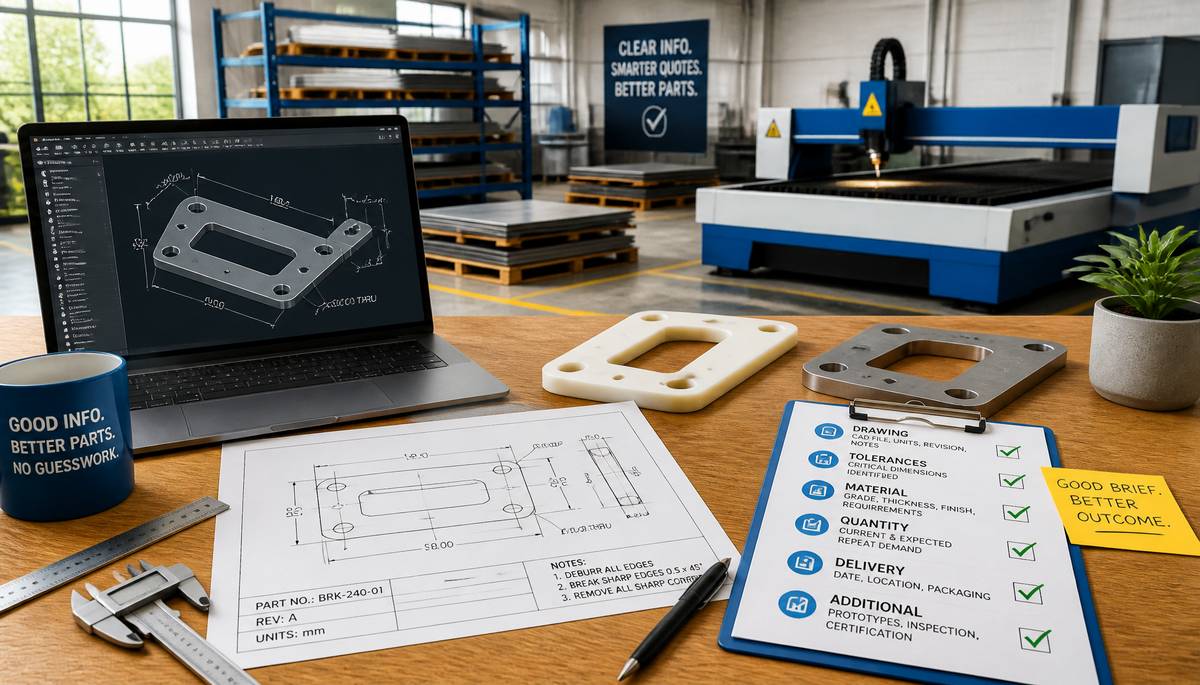 A custom part can begin life as a neat digital drawing and still arrive at the factory resembling a small administrative mystery. The geometry may be clear, the idea may be sound, and everyone may be keen to move forward, yet a missing tolerance, uncertain material grade or vague quantity can stop a quotation before it has properly begun. For procurement teams, the fastest route to a dependable custom-cut component is not chasing suppliers harder. It is supplying the right information at the outset.
Start with a Drawing That Can Be Manufactured
A CAD file is usually the best starting point, particularly when it is supplied in a widely usable format such as DXF, DWG, STEP or an appropriately prepared PDF drawing. It gives the manufacturer a workable basis for assessing shape, dimensions, machining requirements and material usage. However, a file alone is not always enough. A supplier still needs to know which dimensions matter most, whether holes require particular diameters, and if edges need finishing beyond a standard cut.A clear drawing should identify the part number, revision level, units of measurement and any essential notes. This avoids the remarkably expensive situation in which one team assumes millimetres, another assumes inches, and a modest bracket suddenly acquires the footprint of a garden bench. Revision control matters just as much. If a drawing changes after quotation, make the change obvious rather than sending a file called final_final_revised_reallyfinal.dxf.
Where possible, procurement teams should also provide a simple written description of the component’s purpose. The manufacturer does not need a memoir, but knowing whether a panel is a food-area liner, a wear strip, a chemical-resistant guard or a decorative sign can reveal questions the drawing does not answer. Context often prevents a technically accurate part from becoming a practically unsuitable one.
Specify Tolerances Before They Become an Argument
Every manufactured part has variation. The question is how much variation the finished application can tolerate. A dimension that can vary slightly is very different from one that must align with another component, fit inside a housing or support a moving mechanism.Tolerances should be stated only where they are genuinely necessary. Applying extremely tight tolerances to every dimension can increase machining time, inspection requirements and cost without improving the final product. It is the industrial equivalent of demanding every office chair be positioned with laboratory precision before a meeting. Focus instead on critical features: hole positions, mating edges, thickness requirements, slots, cut-outs and any location where the component interacts with another part.
If a team is unsure what tolerance is appropriate, it is better to say so early and ask the manufacturer for guidance. An experienced fabricator can often recommend a practical tolerance based on material behaviour, cutting method and intended use. That conversation is far cheaper before production than after a batch has been made.
Material Requirements Need More Than a Generic Label
“Plastic,” “metal” or “sheet material” is rarely a sufficient specification for a custom component. Material selection affects strength, weight, chemical resistance, temperature performance, surface finish, food-contact suitability and long-term durability. Two materials may look broadly similar on a spreadsheet while behaving very differently after months of friction, moisture or cleaning chemicals.Procurement teams should state the exact grade where it is known, along with thickness, colour, finish and any compliance requirements. If the material must resist impact, work outdoors, handle repeated washdowns or avoid contaminating a sensitive process, those conditions belong in the enquiry. A manufacturer cannot reliably infer that a component destined for a warehouse will also spend its working life being bumped by forklifts, hosed down on Fridays and occasionally inspected by someone with a clipboard.
When the material has not yet been selected, describe the operating environment instead. Explain what the component touches, how it is loaded, whether it is exposed to chemicals, and the temperatures it may encounter. This gives the supplier enough information to suggest suitable options without turning the quotation process into an elaborate guessing game.
Quantities and Timescales Shape the Quotation
A prototype, a short production run and a recurring order may use the same drawing, but they are not the same commercial job. Quantity affects material purchasing, setup time, nesting efficiency, tooling decisions, packaging and unit cost. Providing an accurate expected quantity helps manufacturers quote sensibly from the beginning.It is also useful to state whether the initial order is likely to lead to repeat purchases. A supplier may recommend a more efficient production approach if it knows a batch of ten could become a regular order of several hundred. Equally, teams should be honest about their timeline. An urgent requirement should be raised immediately, not quietly inserted into an email after the drawing has been approved and everyone has mentally moved on to lunch.
A useful enquiry normally includes:
- Current quantity and expected repeat demand
- Required delivery date and delivery location
- Preferred packaging or labelling requirements
- Whether prototypes or sample parts are needed first
- Any inspection, certification or documentation requirements
Cutting Through the Delay
Custom-part procurement becomes much smoother when drawings, critical tolerances, material requirements and quantities arrive together as one coherent brief. This allows the manufacturer to assess feasibility, identify questions early and provide a quotation that reflects the actual work rather than a collection of assumptions.The reward is not merely a faster price. It is fewer revisions, better communication, more dependable lead times and a component that fits its intended job when it arrives. A well-prepared enquiry turns the supplier into a practical manufacturing partner, rather than an unwilling detective trying to establish whether a missing dimension was intentional or simply escaped during a busy Tuesday afternoon.
Article kindly provided by sandhillplastics.com
Latest Articles
- From CAD File to Finished Component: How Procurement Teams Can Avoid Custom-Part Delays
- The Repair-or-Replace Calculation: When an Older Computer Is Still Worth Saving
- Why Commercial Roof Problems Often Start as Access Problems
- The Cybersecurity Weakness Most Businesses Overlook
- Waste Audits for Small Businesses: The Simple Exercise That Can Cut Costs
- Why Fitness Goals Fail at Work but Succeed at Home
- The Hidden Cost of Guessing What Your Competitors Are Doing
- Why the Best Commercial Sites Are Designed Around Traffic Flow Before Appearance
- Designing Offices That Still Work Five Years From Now
- Why the Most Successful Commercial Landscapes Prioritise Function Before Appearance
- How Businesses Can Stay Operational During Major Refurbishment Works
- Near Misses: The Most Valuable Workplace Incidents You're Probably Ignoring
- Choosing the Right Lifting Method Before Choosing the Equipment
- Why Visitors Ignore Half Your Homepage Within Three Seconds
- Why Most Cybersecurity Conversations Ignore the Biggest Vulnerability: Everyday Workflow Habits
- What Your Workplace Is Communicating Before Anyone Says a Word
- Planning an Office Renovation? Why Drywall Decisions Impact More Than Just the Walls
- The False Economy of Low-Cost Protective Solutions
- The Valuable Materials Hiding in Everyday Electronics
- The Hidden SEO Asset Most Small Businesses Ignore: Why Directory Listings Still Matter
- Sales and Marketing
- Human Resources
- Finance and Accounting
- Business Consulting
- Information Technology
- Supply Chain Management
- Manufacturing and Production
- Logistics and Transportation
- Risk Management
- Project Management
- Market Research
- Business Intelligence
- Customer Relationship Management
- Product Development
- Quality Assurance
- Outsourcing Services
- Procurement and Vendor Management
- Legal and Compliance
- Business Strategy
- Operations Management
- Leadership and Management
- Data Analytics
- Innovation and R&D
- Training and Development
- Ecommerce Solutions
- Public Relations
- Advertising and Promotion
- Branding and Identity
- Business Networking
- Event Management
- Office Environment