

The Hidden Cost of Guessing What Your Competitors Are Doing
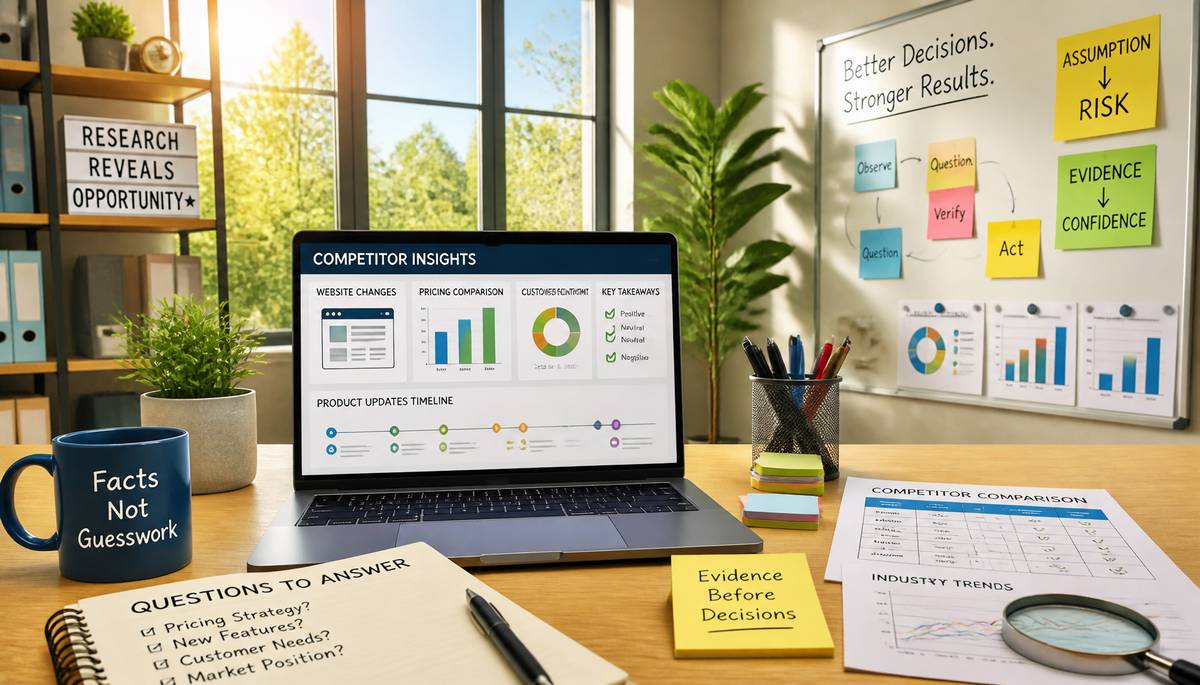 Every business has that tempting moment when someone confidently announces, "I know exactly what our competitors are planning." Sometimes that confidence is backed by careful research. More often, it is powered by wishful thinking, a handful of social media posts, and the mysterious ability of office gossip to become accepted as fact after being repeated three times. Decisions made on assumptions can feel fast and efficient, but they often send companies in entirely the wrong direction.
Guesswork has an unusual talent for looking convincing. It saves time in the short term because there is no need to gather evidence, verify information, or challenge existing beliefs. Unfortunately, it also has a remarkable ability to generate expensive surprises. Businesses may invest in unnecessary features, slash prices without reason, or launch marketing campaigns aimed at solving problems that never actually existed.
Confidence Is Not Evidence
Many business decisions begin with phrases such as "I bet they're..." or "They've probably..." Those statements might sound harmless during a meeting, but they can quietly influence major strategic choices.Imagine assuming a rival is preparing to launch a premium service. In response, a company rushes to create its own premium offering, reallocates staff, adjusts pricing, and redesigns marketing materials. Weeks later, it becomes clear the competitor never had those plans at all. The entire project was built around an imaginary threat.
That sounds dramatic, yet similar situations happen surprisingly often. Businesses sometimes react to rumours instead of reality, confusing movement with progress. Running quickly in the wrong direction is still running in the wrong direction.
Research Does Not Need to Be Complicated
Evidence-based research sounds like something requiring a dedicated department filled with giant screens, endless spreadsheets, and someone dramatically saying, "Zoom in on that graph."In reality, useful competitive research often begins with simple habits.
- Monitor competitor websites for genuine changes.
- Read customer reviews to identify recurring complaints and praise.
- Follow industry news instead of relying on speculation.
- Compare public pricing, product updates, and service offerings over time.
- Keep notes rather than trusting memory.
Finding the Balance Between Speed and Accuracy
Waiting forever for perfect information creates its own problems. Markets move, customer expectations evolve, and opportunities rarely stand patiently in a queue.The goal is not perfect certainty. It is making decisions based on enough reliable evidence to reduce unnecessary risk. Good businesses understand that there is a practical middle ground between reckless guessing and endless analysis.
Suppose a competitor changes its pricing structure. Rather than immediately matching every adjustment, it makes sense to investigate why the change occurred. Is it attracting new customers? Responding to rising costs? Testing a limited promotion? A little patience can prevent an expensive reaction to something that may disappear within weeks.
Speed certainly matters, but accuracy gives speed direction. Acting quickly on poor information simply helps mistakes arrive earlier.
Too Much Information Can Become Another Problem
Collecting evidence is valuable, but collecting absolutely everything can become a distraction of its own. Some businesses spend so much time monitoring competitors that they forget to pay attention to their own customers. It is possible to know every minor website update made by a rival while remaining completely unaware that your own support inbox is filling with the same complaint every day.Effective research has a purpose. Before gathering information, decide what question needs answering. Are you trying to understand pricing? Product quality? Customer experience? Marketing strategy? Having a clear objective makes it much easier to ignore interesting but ultimately irrelevant details.
Think of information as ingredients in a recipe. A sensible amount creates something useful. Emptying the entire spice rack into the pot rarely produces a masterpiece.
Challenge Assumptions Before They Become Strategy
One of the simplest ways to improve decision-making is to ask an uncomfortable question whenever someone makes a confident claim."What evidence supports that?"
That single question can transform a discussion. Sometimes the answer reveals solid research, reliable customer feedback, or observable market trends. Other times, it uncovers a chain of assumptions that began with a comment at a networking event and somehow evolved into accepted company wisdom.
Encouraging healthy scepticism is not about slowing progress. It is about making sure important decisions have a stable foundation. Teams that feel comfortable questioning assumptions often avoid expensive detours because they identify weak reasoning before it develops into company policy.
Learning Without Copying
Competitor research should inspire smarter thinking, not imitation. Blindly copying another company's pricing, branding, or product features rarely delivers lasting success because every business operates under different circumstances.Perhaps a competitor has introduced free delivery. That sounds attractive, but without understanding how they finance it, matching the offer could quietly damage profitability. They may have negotiated lower shipping rates, operate from different locations, or simply be willing to accept lower margins for strategic reasons.
Evidence helps explain why something is happening rather than simply confirming that it happened. That distinction often separates thoughtful business planning from expensive guesswork.
Guess Less Profit More
Successful businesses are rarely those with magical instincts that never fail. More often, they are organisations that consistently replace assumptions with reliable information before making meaningful decisions.Research does not have to be slow, expensive, or overwhelming. Small, consistent efforts can reveal trends, confirm opportunities, and expose risks long before they become costly surprises. Just as importantly, they provide confidence that comes from evidence rather than optimism alone.
Competitors will always make unexpected moves, and nobody can predict every development. What businesses can control is how they respond. Choosing facts over speculation may lack the dramatic flair of bold guesses made around a meeting table, but it usually produces something far more satisfying when the numbers are finally added up.
Article kindly provided by aqute.com
Latest Articles
- Why the Quietest Toilet in the Building Could Be Wasting the Most Water
- Could Someone Understand Compliance Six Months After It's Written?
- How Much CNC Capacity Is Hidden in Setup Time?
- How to Test a New Freelancer Without Handing Over Your Whole Project
- From CAD File to Finished Component: How Procurement Teams Can Avoid Custom-Part Delays
- The Repair-or-Replace Calculation: When an Older Computer Is Still Worth Saving
- Why Commercial Roof Problems Often Start as Access Problems
- The Cybersecurity Weakness Most Businesses Overlook
- Waste Audits for Small Businesses: The Simple Exercise That Can Cut Costs
- Why Fitness Goals Fail at Work but Succeed at Home
- The Hidden Cost of Guessing What Your Competitors Are Doing
- Why the Best Commercial Sites Are Designed Around Traffic Flow Before Appearance
- Designing Offices That Still Work Five Years From Now
- Why the Most Successful Commercial Landscapes Prioritise Function Before Appearance
- How Businesses Can Stay Operational During Major Refurbishment Works
- Near Misses: The Most Valuable Workplace Incidents You're Probably Ignoring
- Choosing the Right Lifting Method Before Choosing the Equipment
- Why Visitors Ignore Half Your Homepage Within Three Seconds
- Why Most Cybersecurity Conversations Ignore the Biggest Vulnerability: Everyday Workflow Habits
- What Your Workplace Is Communicating Before Anyone Says a Word
- Sales and Marketing
- Human Resources
- Finance and Accounting
- Business Consulting
- Information Technology
- Supply Chain Management
- Manufacturing and Production
- Logistics and Transportation
- Risk Management
- Project Management
- Market Research
- Business Intelligence
- Customer Relationship Management
- Product Development
- Quality Assurance
- Outsourcing Services
- Procurement and Vendor Management
- Legal and Compliance
- Business Strategy
- Operations Management
- Leadership and Management
- Data Analytics
- Innovation and R&D
- Training and Development
- Ecommerce Solutions
- Public Relations
- Advertising and Promotion
- Branding and Identity
- Business Networking
- Event Management
- Office Environment