

How to Test a New Freelancer Without Handing Over Your Whole Project
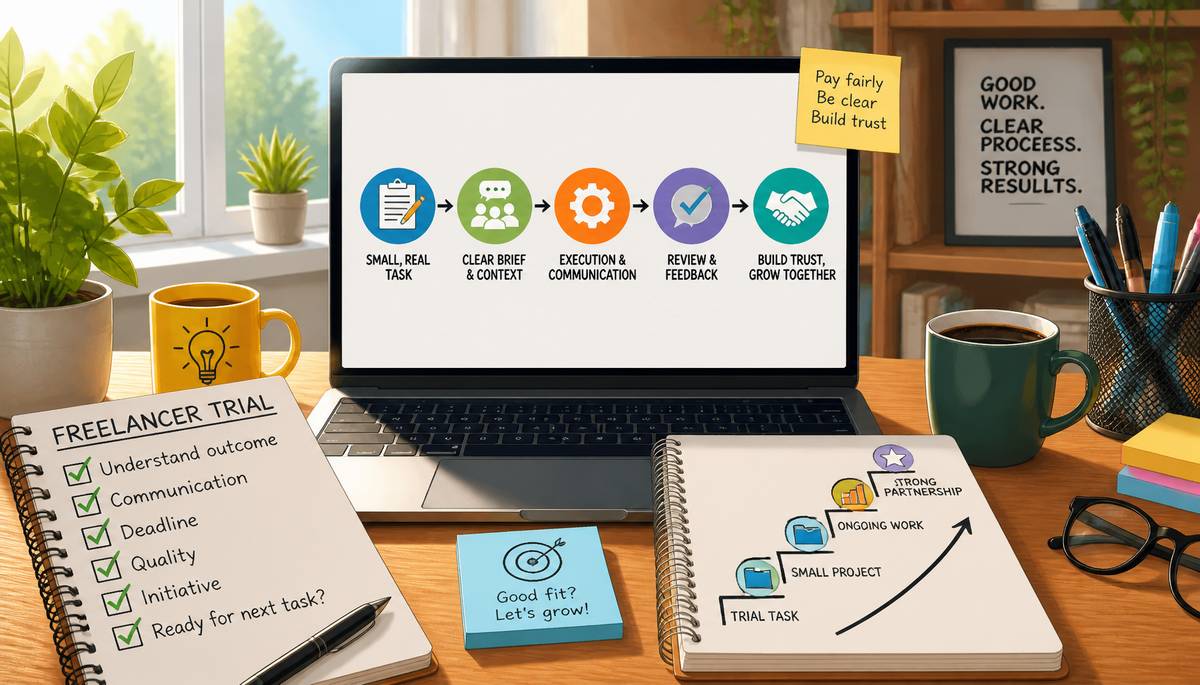 A freelancer’s portfolio is a little like a restaurant menu: it can look magnificent, but it does not tell you whether the kitchen sends out the food warm, on time, and without an unexpected anchovy hiding in the dessert. Before handing over an important website, marketing campaign, software build or design project, it makes sense to arrange a smaller test first.
This is not about trying to get substantial work for free or treating someone as though they are applying for a security clearance. It is about reducing uncertainty for both sides. A well-designed trial task lets you see how a person thinks, communicates and delivers before the stakes become expensive or stressful.
The best test jobs are real enough to matter, but contained enough that a disappointing result does not derail your wider plans. Think of them as a practical first date with a clear deliverable, rather than a marriage proposal accompanied by a spreadsheet.
Choose a Small Task With Real Consequences
Avoid meaningless tests such as asking a writer to produce a fictional paragraph nobody will use, or asking a developer to solve a puzzle designed only to catch them out. These may reveal a little about skill, but they do not show how someone handles an actual business need.Instead, identify a modest piece of work that has a genuine place in your project. A designer could refresh one key social graphic. A copywriter could improve a product page. A web developer could repair a minor but annoying display issue. An SEO specialist could review a small set of pages and provide prioritised recommendations.
The task should have a defined beginning and end. If it starts with “while you are in there, could you also…” it may already be growing legs and preparing to run through a hedge.
Give the freelancer enough context to make sound decisions, including the intended audience, the desired result, relevant brand material and any immovable restrictions. Then leave room for professional judgement. A capable person should not require a fourteen-page instruction manual to change a button colour, but neither should they be expected to read your mind.
Pay Properly for the Trial
A paid test changes the whole dynamic. It signals that you respect the freelancer’s time and that the work has value, even if you ultimately decide not to continue. It also attracts people who take their work seriously, rather than those willing to gamble hours on vague promises of “lots more work later.”Be clear about the budget from the beginning. If the price feels too high for a small trial, reduce the scope rather than expecting a professional to absorb the difference. A smaller paid task is still enough to reveal a great deal.
Payment also gives you a useful insight into how the person manages a normal commercial arrangement. Do they confirm what is included? Do they ask sensible questions before beginning? Do they raise a concern early if an assumption turns out to be wrong? These details often matter more than an immaculate-looking first draft.
Watch the Work, Not Just the Result
A finished deliverable can be excellent for accidental reasons, and an imperfect one can still come from someone worth keeping. Pay attention to the route taken. Did the freelancer acknowledge the brief clearly? Did they establish a realistic delivery date? Were updates concise and useful, or did silence descend until the deadline began looming like an unpaid electricity bill?Technical ability matters, of course, but reliability is usually what turns a good freelancer into a trusted long-term collaborator.
Ask Questions That Reveal Judgement
A useful trial should include at least one point where the freelancer must make a decision rather than merely follow instructions. You may ask a designer to suggest two visual directions, a developer to explain the safest fix for a fault, or a writer to identify missing information before drafting. Their response can tell you whether they simply complete tasks or actively improve them.Strong freelancers usually ask focused questions. They do not bombard you with queries that could have been answered by opening the file you sent, but they also do not charge ahead on a guess that could have been avoided with one sensible message.
Look for someone who can explain their thinking in plain language. You do not need a technical lecture involving seventeen acronyms and a diagram that resembles a faulty underground map. You need to understand what they recommend, why they recommend it, and what trade-offs are involved.
A freelancer who flags a risk early is often more valuable than one who agrees enthusiastically with every request. If a proposed shortcut could damage a website, weaken security or produce poor-quality work, the right person should say so calmly and offer a better route.
Use a Simple Scorecard
Once the trial is complete, assess it against a few criteria rather than relying entirely on first impressions. Charm is pleasant, but it does not repair a checkout page at eleven o’clock on a Friday night.- Did they understand the desired outcome?
- Was their communication clear and appropriately timed?
- Did they meet the agreed deadline?
- Was the work accurate, usable and properly checked?
- Did they show initiative without wandering beyond the brief?
- Would you feel comfortable giving them a slightly larger task?
Build Trust in Stages
If the trial goes well, do not immediately hand over every important account password, brand asset and unfinished idea you have ever scribbled on the back of an envelope. Increase responsibility gradually. Move from one small task to a slightly more involved assignment, then perhaps to a recurring piece of work.This staged approach gives both parties time to develop a shared rhythm. The freelancer learns your preferences, standards and priorities. You learn whether their good first impression survives real deadlines, changing requirements and the occasional project that arrives with one missing file and a mysterious instruction from six months ago.
For work involving sensitive access, use sensible safeguards from the beginning. Provide only the permissions needed for the task, keep ownership of key accounts, and document what has been changed. Trust is not weakened by good process; it is protected by it.
Contractually Yours
A small paid test is not an obstacle between you and outsourcing. It is the bridge that makes outsourcing less nerve-racking and more useful. By choosing a contained, meaningful task and watching how the work is handled, you can make your next decision with evidence rather than hope.The aim is not to find a flawless human being who never needs clarification, misses no detail and replies to messages before you have pressed send. It is to find someone competent, dependable and easy to work with. That is usually more than enough to turn a cautious first assignment into a productive working relationship.
Article kindly provided by zinnhub.com
Latest Articles
- How to Test a New Freelancer Without Handing Over Your Whole Project
- From CAD File to Finished Component: How Procurement Teams Can Avoid Custom-Part Delays
- The Repair-or-Replace Calculation: When an Older Computer Is Still Worth Saving
- Why Commercial Roof Problems Often Start as Access Problems
- The Cybersecurity Weakness Most Businesses Overlook
- Waste Audits for Small Businesses: The Simple Exercise That Can Cut Costs
- Why Fitness Goals Fail at Work but Succeed at Home
- The Hidden Cost of Guessing What Your Competitors Are Doing
- Why the Best Commercial Sites Are Designed Around Traffic Flow Before Appearance
- Designing Offices That Still Work Five Years From Now
- Why the Most Successful Commercial Landscapes Prioritise Function Before Appearance
- How Businesses Can Stay Operational During Major Refurbishment Works
- Near Misses: The Most Valuable Workplace Incidents You're Probably Ignoring
- Choosing the Right Lifting Method Before Choosing the Equipment
- Why Visitors Ignore Half Your Homepage Within Three Seconds
- Why Most Cybersecurity Conversations Ignore the Biggest Vulnerability: Everyday Workflow Habits
- What Your Workplace Is Communicating Before Anyone Says a Word
- Planning an Office Renovation? Why Drywall Decisions Impact More Than Just the Walls
- The False Economy of Low-Cost Protective Solutions
- The Valuable Materials Hiding in Everyday Electronics
- Sales and Marketing
- Human Resources
- Finance and Accounting
- Business Consulting
- Information Technology
- Supply Chain Management
- Manufacturing and Production
- Logistics and Transportation
- Risk Management
- Project Management
- Market Research
- Business Intelligence
- Customer Relationship Management
- Product Development
- Quality Assurance
- Outsourcing Services
- Procurement and Vendor Management
- Legal and Compliance
- Business Strategy
- Operations Management
- Leadership and Management
- Data Analytics
- Innovation and R&D
- Training and Development
- Ecommerce Solutions
- Public Relations
- Advertising and Promotion
- Branding and Identity
- Business Networking
- Event Management
- Office Environment