

Why Most Transport Damage Happens Before the Truck Moves: the Operational Cost of Poor Packing
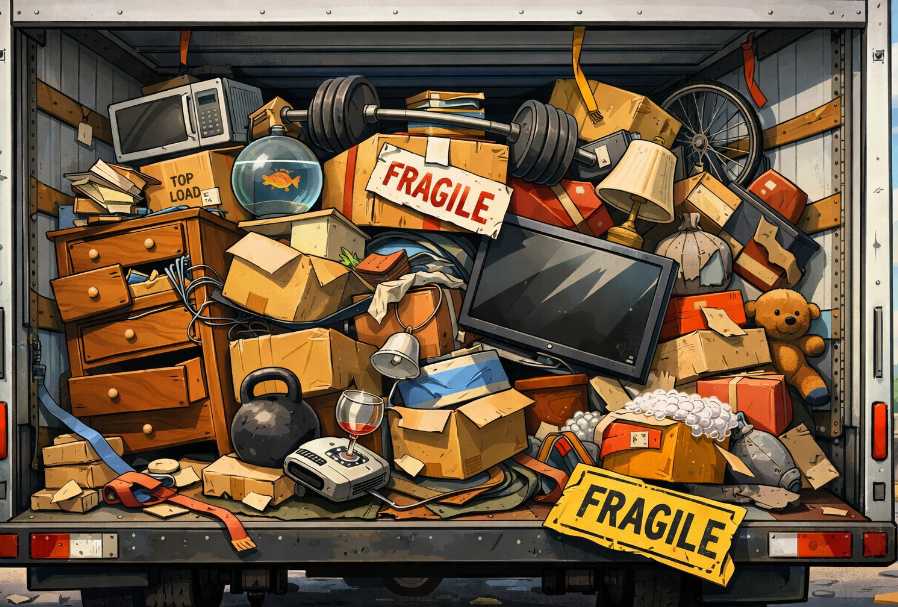 A pallet can cross a city without a scratch and still arrive "broken" because someone treated packing like an afterthought and gravity like a suggestion.
Damage claims often get blamed on bumpy roads, rushed drivers, or "something must've shifted." Sometimes that's true. More often, the damage was baked in long before the tailgate went up: mismatched boxes, loose items, overfilled drawers, unprotected corners, and loads that were never properly restrained. For businesses moving equipment, office furniture, retail fixtures, or high-value items, poor packing isn't just a nuisance. It's an operational cost with a surprisingly long shadow: delays, rework, replacement purchases, lost productivity, and awkward calls that start with "So… about that delivery."
Packing is the first link in the handling chain. Every transfer—warehouse to trolley, trolley to truck, truck to dock—magnifies weaknesses. If the load begins as a wobbly stack of optimism, each touchpoint becomes a dice roll. The goal isn't perfection; it's transport readiness: items packaged and secured so normal handling doesn't turn into a slow-motion demolition.
Packing mistakes that quietly print invoices
Mixing heavy and fragile items in the same box is the classic. A few "small bits" get tossed in with something sturdy, then the sturdy thing becomes a battering ram. The box doesn't look dangerous. It is.Leaving drawers full is another repeat offender. People do it because it feels efficient. It's also how a cabinet becomes a maraca. Contents shift, slam, and distort the drawer tracks. On arrival, the drawer sticks, the handles loosen, and suddenly a simple move turns into a "furniture repair situation."
Skipping edge and corner protection for furniture and equipment is a close third. Corners take the first hit in tight doorways and on truck floors. Without protection, minor knocks become chipped laminates, dented metal, or cracked casing. Those are cosmetic… until they're not, especially for electronics, medical gear, or precision tools.
Then there's the box that's "totally fine" because it's taped shut. If it bulges, tears easily, or collapses when lifted from the bottom, it's not a box; it's a prank with handles.
Load restraint isn't optional just because deadlines are loud
Some paragraphs need a serious tone, and this is one of them.Load restraint is a safety control and a quality control. If items can slide, tip, or fall, damage is a predictable outcome, not a mysterious accident. During braking, turning, and minor road vibration, unsecured cargo migrates. It leans into other items. It rubs. It compresses. It tests every weak point in your packing choices. Even a well-packed item can fail if it's allowed to fall over repeatedly for 45 minutes.
For businesses, the hidden cost is reliability. A delivery that arrives damaged doesn't just create a replacement order. It can stall an office setup, delay a store opening, push back an installation, or disrupt a client handover. The downstream impact often costs more than the item itself because people, time, and schedules are more expensive than plywood and bubble wrap.
At minimum, restraint should prevent movement in all directions. That means thinking in three dimensions: forward/back, side-to-side, and up/down. Gaps inside the load are invitations for shifting, and shifting is how "it looked fine when it left" becomes "why is the leg bent?"
Simple rules that reduce claims and reduce chaos
A little structure goes a long way. Use these practical principles as a baseline for transport readiness:- Weight discipline: Keep heavy items in small boxes and light items in larger boxes. If a box feels like a gym challenge, it's too heavy.
- One job per box: Avoid mixing fragile items with dense hardware. If it can crack, don't pack it with something that could be used as a doorstop.
- Fill voids: Empty space lets items build momentum. Cushion so contents can't move when the box is gently shaken.
- Stabilize drawers and doors: Empty or secure contents, then close and immobilize moving parts with appropriate wrap or straps.
- Protect edges and corners: Use corner protectors or rigid padding where impacts are likely—especially on desks, cabinets, screens, and benchtops.
- Label for handling, not wishes: "Fragile" helps, but clear orientation arrows and "Do not stack" warnings are more actionable.
When efficiency disguises a packing problem
Operational shortcuts often look clever until the truck doors open at the destination. Someone decides it's quicker to stack office chairs loosely, tuck cables into random boxes, and slide a monitor between two cartons "just for the trip." The trip then becomes a physics experiment.Speed during packing rarely translates to speed at delivery if damage appears. Staff end up documenting issues, checking inventory, contacting suppliers, or improvising repairs with tools that were meant for assembly, not forensic reconstruction. A five-minute shortcut quietly turns into a two-hour detour.
Consider electronics. Monitors and equipment that travel without rigid support are especially vulnerable. Screens flex slightly when pressure is applied. Place a heavier object against them during transport and that gentle flex becomes a spiderweb crack. Nobody remembers exactly when it happened; the box simply opens to reveal the world's most expensive abstract art.
Furniture can suffer the same fate. Flat surfaces behave well when they're upright and supported. Lay them poorly across other items and they begin absorbing pressure unevenly. What arrives looks less like furniture and more like a mild architectural theory about curves.
Businesses moving valuable equipment sometimes assume the truck itself provides protection. Trucks are excellent at transporting cargo across distances. They are not magical shock absorbers for poorly prepared items.
Building a packing culture instead of a packing scramble
Companies that move goods frequently tend to build quiet systems around packing. Not complicated systems. Just consistent ones.Standard materials matter. Boxes of reliable strength prevent mid-lift collapses. Protective wrap is stocked in sensible quantities instead of scavenged from whatever packaging happened to arrive last week. Corner protectors and straps become normal tools rather than rare sightings.
Training also plays a role. Staff who understand why certain methods work tend to repeat them. Someone shown how weight shifts inside a box during braking immediately sees why void fill matters. Once witnessed, the lesson sticks longer than any printed instruction sheet.
There's also value in simple staging zones. Items grouped by fragility, size, and destination reduce last-minute improvisation. When packing becomes orderly rather than frantic, mistakes quietly disappear.
Another overlooked factor is communication between teams. If the loading crew knows an item contains sensitive equipment or calibrated tools, they'll treat restraint and positioning differently. If nobody mentions it, the item receives the same treatment as a stack of empty shelving panels.
Consistency doesn't slow operations. It removes surprises.
Boxes behaving badly
By the time a damaged item arrives, the evidence usually points back to the packing stage. A crushed corner suggests poor stacking discipline. Loose contents hint at empty space inside a carton. Scratches along a surface reveal friction during movement.Packing done properly rarely attracts attention. Everything arrives quietly intact. People sign paperwork, carry on with installations, and nobody thinks twice about the cardboard that made it possible.
Packing done poorly, on the other hand, writes a small comedy of errors. The drawer that refuses to open. The cabinet door that now closes with philosophical hesitation. The monitor that displays nothing except a crack shaped vaguely like a lightning bolt.
Preventing these outcomes doesn't require elaborate logistics theory. It requires a few simple disciplines applied consistently: protect edges, control weight, eliminate empty space, secure moving parts, and restrain the load so it behaves like one stable unit rather than a travelling pile of optimism.
Damage during transport rarely begins on the road. It usually starts when someone looks at a half-packed box and says, "That'll do."
Article kindly provided by tommystransport.com.au
Latest Articles
- Could Someone Understand Compliance Six Months After It's Written?
- How Much CNC Capacity Is Hidden in Setup Time?
- How to Test a New Freelancer Without Handing Over Your Whole Project
- From CAD File to Finished Component: How Procurement Teams Can Avoid Custom-Part Delays
- The Repair-or-Replace Calculation: When an Older Computer Is Still Worth Saving
- Why Commercial Roof Problems Often Start as Access Problems
- The Cybersecurity Weakness Most Businesses Overlook
- Waste Audits for Small Businesses: The Simple Exercise That Can Cut Costs
- Why Fitness Goals Fail at Work but Succeed at Home
- The Hidden Cost of Guessing What Your Competitors Are Doing
- Why the Best Commercial Sites Are Designed Around Traffic Flow Before Appearance
- Designing Offices That Still Work Five Years From Now
- Why the Most Successful Commercial Landscapes Prioritise Function Before Appearance
- How Businesses Can Stay Operational During Major Refurbishment Works
- Near Misses: The Most Valuable Workplace Incidents You're Probably Ignoring
- Choosing the Right Lifting Method Before Choosing the Equipment
- Why Visitors Ignore Half Your Homepage Within Three Seconds
- Why Most Cybersecurity Conversations Ignore the Biggest Vulnerability: Everyday Workflow Habits
- What Your Workplace Is Communicating Before Anyone Says a Word
- Planning an Office Renovation? Why Drywall Decisions Impact More Than Just the Walls
- Sales and Marketing
- Human Resources
- Finance and Accounting
- Business Consulting
- Information Technology
- Supply Chain Management
- Manufacturing and Production
- Logistics and Transportation
- Risk Management
- Project Management
- Market Research
- Business Intelligence
- Customer Relationship Management
- Product Development
- Quality Assurance
- Outsourcing Services
- Procurement and Vendor Management
- Legal and Compliance
- Business Strategy
- Operations Management
- Leadership and Management
- Data Analytics
- Innovation and R&D
- Training and Development
- Ecommerce Solutions
- Public Relations
- Advertising and Promotion
- Branding and Identity
- Business Networking
- Event Management
- Office Environment